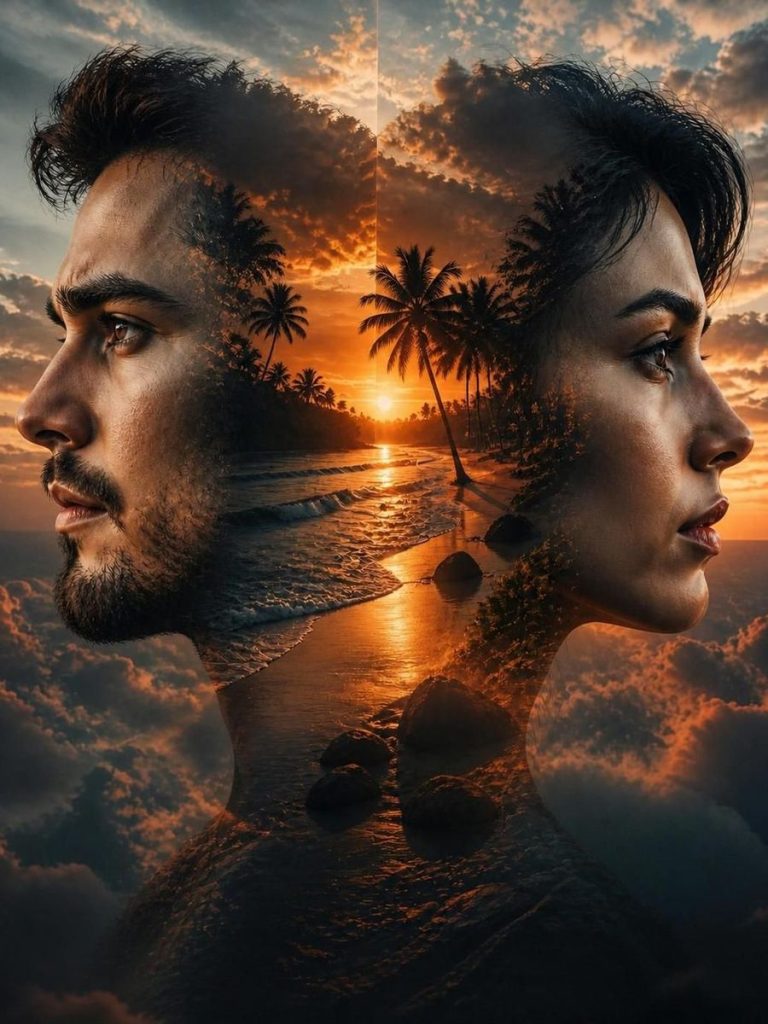
Creating a Cinematic Symmetrical Double Exposure
From human face to landscape: the technique that blends portrait and nature into a single, perfectly balanced image
The Problem (The Challenge)
Double exposure is one of the most fascinating techniques in digital art, but also one of the hardest to achieve with AI. When you try to blend two photorealistic faces with a complex landscape, the models tend to confuse the visual planes: features deform, textures blur together and symmetry is lost. The result? An unbalanced image, far from the cinematic elegance you want.
Technical Context
Until now, achieving a clean blend between ultra-detailed human profiles and natural environments required manual compositing steps, layer masks and lighting corrections. AI generators struggle to keep faces sharp when they have to handle elements such as waves, palm trees, sunset reflections and atmospheric depth. The real challenge is making the model understand how to distribute the elements across two perfectly symmetrical hemispheres.
The Solution (The “Trick”)
The breakthrough comes from defining the image structure before the content. In the prompt we imposed a clean vertical split, assigning a distinct profile to each side (man on the left, woman on the right) and tying the landscape blend to their features. The AI does not have to “guess” the composition: it is built for it mathematically. The key is to describe the landscape as set into the faces, not overlaid on them. This keeps the portraits photorealistic and the textures clean.
A Technical Curiosity
To get a cinematic sunset without the AI generating artifacts or excessive glare, we used a controlled contrast between cool tones (the grays and whites of the landscape) and a warm orange light coming from the sky. Specifying atmospheric depth and the symmetry of the composition helps the most advanced models - such as ChatGPT Image 2.0 and Adobe Firefly - distribute the visual masses correctly, avoiding facial distortion.
The Call to Action
Do you want to replicate this double exposure in your own projects? We have prepared a complete guide with the extended prompt and the compressed version, optimized for the main generation engines. Download the free resource below and start creating cinematic images with a perfect blend of portrait and landscape.